Say Maya Rodriguez opens a worksheet draft at 6:12 p.m. Twenty-seven lines of clean text. Eight questions, an exit ticket, a separate answer key. The coffee in her mug has gone cold again.
She fed a general assistant such as ChatGPT, Claude, Gemini or Microsoft Copilot a prompt with context, goal, constraints and output shape. The draft still carries risks she can name. A source that does not exist. An answer key that contradicts the textbook page open beside her. One question written at a reading level too high for her mixed eighth-grade class.
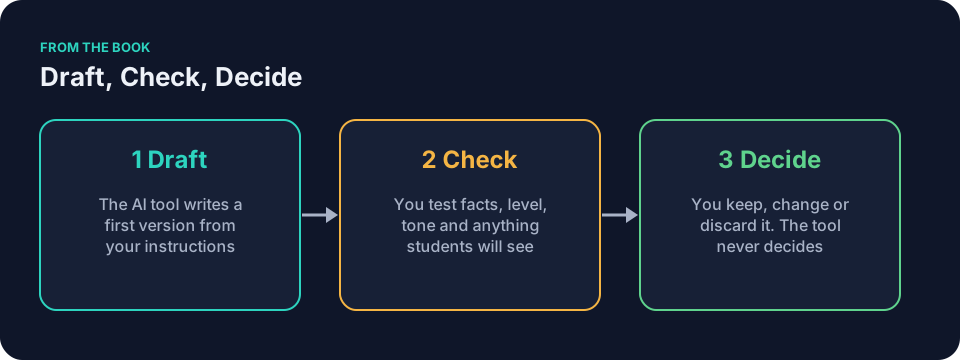
The output looks finished. It is not. The tool drafts. You check. You decide. Nothing reaches students until the check is done. That is the whole routine for evaluating AI-generated content, and the checks apply where they are relevant: a draft without an answer key still needs its facts, level, bias, instructions and sources examined.
Why the tool sounds certain and still errs
These systems predict likely next words from patterns in their training data and in the words you provide. Even when a tool searches or uses documents you provide, you still need to check each claim against the material you trust. The result is fluent prose that can still be wrong.
If you want the longer version, what generative AI is, explained plainly for teachers covers it. The practical consequence is short: everything gets checked. Tools and their settings change, so no routine can rely on a particular button or menu.
Before you check: what may go into the tool at all
Checking a draft is one decision. Deciding what you may paste into the tool is an earlier one, and it comes first.
Use three colors. Green means go ahead: generic planning, public information, a worksheet about photosynthesis with no student names. Yellow means ask first: anonymized student work, a comment bank you plan to adapt, anything that touches a real child. Red means stop: nothing identifiable goes into a tool your school has not approved.
Your school’s policy outranks any article, including this one. If you are unsure which color a task is, ask before you paste. UNESCO, Guidance for generative AI in education and research (2023) is global guidance on generative AI in education and research. Check your school’s policy for the rules that apply to your classroom.
Before evaluating AI-generated content, check that your prompt contained only material your school permits you to share.
The six checks, as a procedure
Open the draft and your trusted materials at the same time. Work in this order so the biggest problems surface first. For each check, you mark the draft in place, and each mark ends in one of four results: keep, repair, verify further, or discard.
Check the facts first. Read each factual claim against the textbook, district curriculum or primary document you trust. Underline anything that contradicts those sources, and circle numbers, dates, formulas and definitions. A circled item you cannot confirm is marked verify further. A claim your trusted source flatly contradicts is marked repair or discard.
Next check the level. Compare sentence length, vocabulary and concept density to what your students handle on an ordinary Tuesday. Count the words in the longest sentence. Mark any passage that reads like adult prose with an L in the margin; those get rewritten until they sound like your room. If the whole draft sits above your readers, that is a discard.
Then check for bias. Look for loaded language, unbalanced examples and assumptions about culture or prior knowledge. A prompt that asks for real-world examples can still produce a narrow set of references. Mark each narrow example with a B. Most B marks are repairs: swap the example, keep the item.
Check clarity of instructions after that. Read every direction as if you were a student who already feels behind. Does each sentence tell the learner exactly what to do? Vague verbs such as “discuss” or “explore” invite confusion. Mark each muddy direction with a C and rewrite it, or cut the item.
Check the answer key next. Solve every item yourself before you read a single line of the generated key. Then compare. Mark each key entry K for keep or R for repair, and note where the key’s explanation contradicts your solution. The worked example below shows why this order matters.
Finally check the sources. If the draft lists references, verify every one, not the two that look suspicious. Checking two citations does not verify the third. Mark each source S for supported, D for dead link, U for unverified, or N for a real source that does not support the claim. The next section explains those marks.
Evaluating AI-generated content: a worked example in science
Picture Maya in her eighth-grade classroom. The photosynthesis unit sits on her desk. The draft includes this item.
Question 4: Which gas do plants absorb from the air for photosynthesis?
A. Oxygen
B. Carbon dioxide
C. Nitrogen
D. Hydrogen
The generated key says: “4. A — Plants absorb oxygen, which they convert into glucose.”
Solve it yourself first. Plants absorb carbon dioxide for photosynthesis. Oxygen is what they release. The correct answer is B. The key picked A and then wrote an explanation that reverses the process. Left in place, that key would reinforce the exact misconception the unit exists to correct.
The corrected key reads: “4. B — Plants take in carbon dioxide and release oxygen during photosynthesis.” And the corrected instruction to students, if the class keeps mixing the two gases up, becomes: “For each answer, write one sentence naming the gas that goes in and the gas that comes out.”
Two errors hid inside one line. The wrong letter. An explanation that stated the misconception as fact. Both surface only when you work the item before you read the key.
One wrong entry means you check every entry, not just the one you caught. If the key needs substantial rebuilding, or you can no longer trust it, discard the draft.
Spotting invented sources
Citations fail in three different ways. Each needs a different response.
A dead link is the mildest failure. The URL returns an error page. This alone proves nothing, because sites move and pages get taken down. Search for the exact title before you conclude anything. If the page turns up elsewhere and supports the claim, mark it S and update the link.
An unverified publication is more serious. The title, journal or author turns up nowhere, no matter how you search. The citation looks plausible: a real-sounding journal, a recent date, an author with a common academic name. Treat it as unverified. Remove or replace every claim that depends on it unless you can locate and read the original.
A real publication that does not support the claim is the quietest failure. The article exists, but it says something narrower, older or different from what the draft asserts. Check the title, author, publication and the specific supporting passage independently. A real article cited for a claim it does not make is still a failed source.
One unverifiable citation is reason to check the remaining citations and every claim built on them. Do not ask the same assistant to confirm its own reference. Locate the original publication or the document you supplied, and read the passage yourself.
With a document-grounded tool such as NotebookLM, the same rule holds. Check each claimed passage against the documents you provided. No tool retrieves, quotes, cites or counts with guaranteed accuracy. The teacher checks it.
Answer-key errors across subjects
The science example is not special. Keys fail the same way in every subject, and the scenes below are illustrations, not reports.
Say Frank Bell, the veteran social studies teacher, gets a draft on the causes of the American Revolution. The generated key lists “taxation without representation” as the only correct cause and marks every other option wrong. The draft ignores colonial self-government, Enlightenment ideas and economic pressure. Frank crosses out the key and rewrites it to credit several defensible answers.
Say Jordan Kim’s English class has discussed three defensible readings of a character’s motives in a short story. The draft’s key treats one plausible interpretation as the single correct reading and marks the other three incorrect. Jordan replaces the key and adds a line inviting students to defend their own reading with evidence from the text.
Say Denise Carter in the front office asks for a simple parent note about attendance. The draft arrives with legal-sounding language about consequences that she does not recognize. There is no answer key here, because a parent note is not a quiz; the check is the statement itself. She reads it against the school’s attendance policy, finds the claim unverified, and discards the draft rather than send language home that the policy does not support.
In each case the error appears only when the adult works the material first. Check the key against your own solution before you read anything the tool wrote about its own choices.
A second pass: evaluating AI-generated content in elementary math
The routine is the same at every grade. Watch it run start to finish on a different draft.
Say a fourth-grade teacher asks a general assistant for a two-digit multiplication worksheet: eight problems, word problems mixed with bare computation, an answer key, and two “fun fact” boxes about animals to keep the page lively. She opens the draft next to the district math guide and runs the six checks.
Facts first. The first fun fact says a cheetah can run 120 miles per hour. The number is circled. She cannot confirm it against anything she trusts, so the box is marked verify further, and she deletes it rather than chase it. The computation problems check out against her own worked solutions.
Level next. One word problem runs four sentences and forty-one words, with “approximately” and “sufficient” in the same line. It gets an L. She rewrites it as two short sentences: “A bus holds 36 students. How many students can 4 buses hold?” The rest of the page reads like her room.
Bias third. Every word problem names a boy, and the two shopping problems assume a trip to a store with cash in hand. Both get a B. She swaps in varied names and changes one problem to a school garden, a context her students actually share.
Clarity fourth. The direction above the word problems reads “Solve using the appropriate strategy.” Appropriate is doing no work in that sentence. It gets a C and becomes “Solve each problem. Show your work with an area model or partial products.” Now a student who feels behind still knows what to do.
The answer key fifth. In this math worksheet, evaluating AI-generated content means solving all eight problems before consulting the key. Problem 6 asks for 47 times 25; her solution gives 1,175, and the key says 1,075. The key’s explanation skips a place value in the partial products. She marks it R, corrects the number, and rewrites the explanation line. One wrong entry, so she re-verifies the other seven against her solutions. They hold.
Sources last. The surviving fun fact cites a page about animal speeds. The link is dead, marked D. A search for the title finds nothing, so it becomes U. She deletes the box entirely; the worksheet never needed it. Final tally: one deletion, three repairs, one key correction, the rest kept. The draft survives because she can verify and repair what remains.
A worked source check in history
Evaluating AI-generated content gets harder when the citation looks respectable. Say Frank Bell asks for a short reading on the New Deal. The draft claims that one program cut unemployment in half within a year, and it cites a journal article with a precise title, a plausible author and a recent date.
He searches the exact title. Nothing comes up. He searches the author’s name with the journal. Still nothing. He cannot verify the publication, so he removes the claim until he can locate and read a source that supports it. He marks the source U, deletes the sentence, and replaces it with a claim his district textbook makes in plain terms.
Now say a second citation in the same draft points to a real article. The journal exists, the author is real, the year is right. He opens it and reads the passage the draft seems to rely on.
The article discusses a single program in a single state, and it reports a modest change over several years, not a national drop in one year. The source is real but does not support the claim. He marks it N and rewrites the sentence to match what the article actually says, or he cuts the claim.
Two failures, two different fixes. The missing publication means the claim has no ground at all. The real publication that fails to support the claim means the claim must shrink to fit the evidence. Evaluating AI-generated content means telling those two apart, because the repair is different in each case.
A worked instruction-and-level repair in early elementary
The same routine runs in a second-grade classroom. Say a teacher asks for a short reading passage about seeds, with three comprehension questions and a direction line at the top. The draft arrives with a direction that reads: “Employ the text to respond to the ensuing inquiries in complete sentences.”
That direction fails the level check before it fails anything else. “Employ” and “ensuing” are adult words. The sentence runs long. She marks it L and C, then rewrites it in the voice her students hear every day: “Read the passage. Answer the three questions. Write in full sentences.”
The questions themselves need the same pass. One asks students to “infer the author’s primary purpose.” Her second graders can find what the passage says, but “primary purpose” is not language they use. She rewrites the question as “Why do you think the writer made this passage? Point to a sentence that helps you tell.” and keeps the other two after reading them aloud in a child’s voice.
Evaluating AI-generated content in early elementary often comes down to this: read every word as if you were seven. If a direction would stop a reader who already feels behind, it gets rewritten until it would not. The content of the passage may be fine. Check the instructions separately, even if the passage itself looks usable.
When to throw the draft away
There is no magic error count. The stop conditions are practical.
Throw the draft away when the answer key cannot be trusted. A key you have to rebuild from scratch is not a draft anymore. Throw it away when claims you cannot verify depend on sources you cannot find. Throw it away when the repair marks outnumber the items worth keeping, because at that point revision costs more than a blank page.
Then decide what comes next. Sometimes writing it yourself is faster. Sometimes a tighter prompt earns one more try. If you try again, close the window and write the prompt with tighter constraints and a stronger example.
Here is what a tighter version of Maya’s prompt might look like.
You are helping an 8th-grade science teacher draft a worksheet on [topic].
Reading level: sentences under [number] words, vocabulary from [unit or word list].
Write [number] questions: [question types], each targeting the misconception that [misconception].
Include one exit ticket intended for a [number]-minute slot.
Put all answers in a separate answer key at the end, with a one-sentence explanation for each.
Do not include sources, links, or citations.
The constraints narrow the draft’s options. Reading level. Question count. Target misconceptions. A separate key. No invented references to chase. You still check both the questions and the key, because a better prompt is an instruction, not a verification. The prompt is the instruction, not the product.
Common mistakes with evaluating AI-generated content
Each mistake below has a distinct action. Match the mark to the fix.
If you skimmed the draft and trusted the confident tone, stop and run the fact check you skipped. Circle every number, date and definition, and confirm each against your trusted material before anything else.
If you accepted the answer key without solving the items, set the key aside and work every item yourself. Compare your solutions to the key only after your own answers are on paper.
If you checked only the suspicious-looking links, go back and verify every citation, including the respectable ones. A real publication that fails to support the claim hides behind a familiar journal name.
If you have been repairing the same draft for half an hour, count the marks. When repairs outnumber keeps, discard the draft and start with a tighter prompt or a blank page.
Connect the routine to your existing workflow
The teacher’s AI checklist: before, during and after covers any AI-assisted task in three stages: what to decide before you open the tool, what to watch while you work, and what to verify before anything reaches students. Print it once and keep it beside your keyboard.
When you write assessment items, the same discipline applies. A tool can draft questions that target specific misconceptions and supply plausible distractors. It cannot decide which misconceptions matter in your room this year, and it should not make high-stakes grading calls. That call stays with you. The fuller discussion is in AI for assessment: better questions in less time.
If your school is still writing its rules, the TeachAI, AI Guidance for Schools Toolkit is a free toolkit to help schools write AI guidance. Bring it to whoever owns that conversation, and send every final decision through your school’s approved policy.
The book Keep It Simple: AI for Teachers is built around the same Draft, Check, Decide approach, and one of its chapters is “The Prompt Is the Instruction, Not the Product.” When a draft disappoints, you can make the next prompt more specific. Check the new draft too. The free sample includes that chapter.
Questions teachers ask
How many times should I run the routine for evaluating AI-generated content?
Run it once per draft, in order, so the biggest problems surface early. If a substantial rewrite follows, rerun every check the rewrite touches: the facts in any new sentence, the answer key if any item changed, and the sources for any new claim.
What if the tool invents a source that looks perfect?
Treat it as unverified until you locate the original. Search the exact title, author and journal. If nothing appears, delete every claim that rests on it. Do not ask the same tool to fix its own citation.
Can I use this routine with a teacher-specific tool such as MagicSchool or Brisk?
Yes. The tool still drafts, and you still check facts, level, bias, clarity, the answer key and sources. The forms may feel more structured. The verification steps stay the same.
How do I check reading level without a formula?
Read the draft aloud in the voice your students use. Count the words in the longest sentence. If you stumble, inspect that sentence for unfamiliar vocabulary or too many ideas. Compare the page to last week’s handout that worked, and adjust until it matches.
What counts as bias in a math worksheet?
Examples that always feature one kind of family, one neighborhood or one set of interests. Assumptions that every student has broadband at home or a quiet place to work. The routine asks you to notice those patterns before students do.
When is it faster to write the material myself?
When the draft’s repair burden outweighs what it saves you. That means a key you cannot trust, sources that collapse under inspection, or repairs on so many items that the original draft has effectively disappeared. The routine exists to make that line visible.
Tonight, open the last draft a tool produced for you and solve its first three items before you read the key. Compare your answers with the key, and mark any disagreement for repair.