At 7:12 p.m. Maya Rodriguez stares at a half-finished quiz on energy transfer. Twenty-three students will sit in front of her in less than fourteen hours. The questions from last year still miss the exact misconception that keeps surfacing. Cold does not move from the ice pack into the soda can. She needs better items tonight.
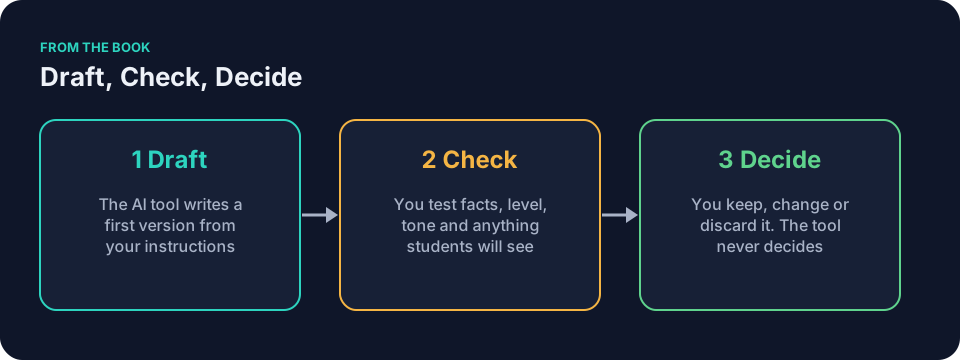
A general AI assistant such as ChatGPT, Claude, Gemini or Microsoft Copilot can draft those questions. The tool cannot replace your judgment. It drafts. You check. You decide. That loop, called Draft, Check, Decide, is the whole method behind AI for assessment.
AI for assessment starts with the misconception
Name the exact error you want to catch. Picture a student who believes cold travels from a cold object into a warm one. Tell the tool to write an item that makes that mistake look tempting.
A strong prompt lists the misconception as a constraint. It adds the facts students must know, the grade level, and the time limit. The prompt is the instruction, not the product.
Here is a reusable block.
You are helping a [grade]-grade [subject] teacher create assessment items.
Context:
- Topic: [topic]
- Objective: Students explain [taught content]
- Students often think [misconception]
Goal: Draft one multiple-choice question that reveals whether students hold the target misconception.
Constraints:
- One multiple-choice item with one strong distractor based on the misconception
- Plain language, no diagrams, no equipment needed
- Separate answer key
Output shape:
1. Student version
2. Teacher version with misconception note
3. Separate answer key
Review: Flag any item that could have more than one correct answer. List every scientific claim I must verify.
After drafting, wait for my revision requests.
Paste it into a school-approved general assistant. The draft may contain usable pieces or clear errors. The tool predicts likely text. It does not know your exact curriculum unless you supply it. You still check every item.
Maya receives something like this for her energy-transfer quiz.
Student version
Maya places a cold can of soda into a bowl of warm water. After ten minutes, the soda is warmer and the water is cooler. What happened?
A. Cold moved from the soda into the water.
B. Heat moved from the water into the soda.
C. The soda absorbed cold from the ice pack in the cooler.
D. The water created heat that moved into the soda.
Teacher version with misconception note
Target misconception: Cold moves from a cold object into a warm one.
Correct answer: B. Heat moves from the warmer object to the cooler one.
Distractor A matches the misconception. Distractor C introduces an irrelevant detail. Distractor D gets the direction right but wrongly claims the water creates heat.
Separate answer key
Correct answer: B. Heat transfers from higher temperature to lower temperature. Cold does not move.
Maya reads the key against her notes. She confirms that heat moves from warm to cool. She confirms that cold does not transfer. She checks that the explanation matches what she taught about particle motion. Then she notices option C mentions an ice pack that is not in the problem. She deletes that phrase and replaces it with a simpler wrong answer about the can itself.
Revised choice C
C. The can kept the cold from moving into the water.
Revised teacher note for C
Distractor C wrongly suggests the can blocks cold from moving. Cold does not move; heat moves from the water into the soda and can.
Revised separate answer key
Correct answer: B. Heat transfers from higher temperature to lower temperature. Cold does not move. The can does not keep cold in place; it warms as heat moves into it. Water does not create heat.
Why the answer key needs checking line by line
Read every line of the key against your trusted source. If the draft claims heat disappears at equilibrium, reject it. If it invents a fact about particle speed your unit never covered, delete it. If two answers look defensible, rewrite the stem or choices until only one is correct.
Take Maya’s item again. The key says B is correct because heat moves from warmer to cooler objects. She checks that statement against her curriculum guide. It matches. The key says A is wrong because cold does not move. She checks that too.
The teacher note says C is wrong because the can does not trap cold. She agrees and confirms her students know the can warms as heat enters it. The note says D is wrong because water does not create heat. She confirms her students know heat transfers but does not appear from nowhere. She keeps D.
The checking routine from How to check AI-generated content before it reaches students makes this step concrete. Draft, Check, Decide turns into facts first, then reading level, then bias or ambiguity, then whether the key matches exactly what you taught. Only after that do you decide which items stay.
Save the prompt with your notes about what needed fixing. Next month you swap the topic and reuse the block. The saved prompt records constraints and corrections you can build on.
Build distractors that reveal thinking
Good distractors mirror the exact mistake students make. Ask the tool for four choices where three reflect common misconceptions and one matches correct reasoning. Then inspect each one.
Say Frank Bell drafts questions about the American Revolution. He targets the misconception that the Boston Tea Party protested high tea prices. The tool offers a distractor claiming colonists objected to the cost of imported tea. Frank checks his notes. In Frank’s unit the colonists objected to Parliament’s authority to tax them without representation and to the Tea Act’s arrangements for tea sales. He rewrites the distractor to reflect that specific misunderstanding before he prints the quiz.
To test whether a distractor reveals the intended misconception, ask yourself what answer a student would pick if they held that belief. If a student chooses it, you have a clue about their thinking. Ask for an explanation before treating it as evidence of that misconception. If it does not, rewrite it.
When you use AI for assessment, write down the mistaken belief each distractor is meant to reveal.
Draft a rubric in one pass
Rubrics take time to write by hand, and AI for assessment can help here too. A general AI assistant can produce a first version when you list the exact success criteria and the number of performance levels.
A typical request might read:
Draft a three-level rubric for the short-answer question on [topic].
Criteria:
- [criterion 1]
- [criterion 2]
- [criterion 3]
Output as a table with one column for each criterion and one row for each level.
The tool returns a draft. One row says “Good understanding of heat.” Maya crosses that out. She writes “States that heat moves from the warmer object to the cooler object.” Another row says “Uses some science words.” She replaces it with “Names particles and describes their motion during transfer.” The rubric now measures what she can observe.
Here is the complete rubric Maya uses for the short-answer question “Explain why the soda can warms up in the bowl of warm water.”
| Criterion | Strong | Partial | Missing |
|---|---|---|---|
| Direction of heat transfer | States that heat moves from the warmer object to the cooler object | States that heat moves but does not specify direction | Does not mention heat transfer |
| Particle motion | Names particles and describes their motion during transfer | Mentions particles without describing motion | Does not mention particles |
| Use of evidence from the scenario | Refers to the soda can and the warm water in the explanation | Refers to the scenario without specific details | Does not refer to the scenario |
Maya checks the science in every level. She confirms that heat moves from warm to cool. She confirms that the particles in the soda move faster as it warms. She confirms that the scenario describes heat transfer through the can.
Check the language against your classroom voice. Adjust the wording so it sounds like what you actually say to students. Then decide which version you will use.
The Education Endowment Foundation, Teacher Feedback to Improve Pupil Learning is guidance on classroom feedback. A drafted rubric gives you a place to start, but you still shape it.
AI for assessment: a worked example in history
Frank Bell needs questions on the causes of the American Revolution. He lists three misconceptions he hears every year: the colonists rebelled mainly over taxes on tea, the Declaration of Independence created a new government immediately, and King George alone decided all colonial policy.
He pastes a version of the misconception-targeted prompt into his approved assistant. He changes the subject and facts. The tool returns four multiple-choice items and one short-answer question.
Frank checks facts against his textbook. One key confuses the Stamp Act with the Townshend Acts. He corrects the date and the description. Another distractor repeats the stem wording too closely. He rewrites it. The short-answer key suggests a four-point scale that mixes effort with accuracy. He replaces it with observable criteria about evidence and explanation.
Here is one complete history question Frank keeps after checking.
Student version
Which statement best explains why colonists protested the Tea Act of 1773?
A. The Tea Act raised the price of tea so high that most colonists could not afford it.
B. The Tea Act kept an existing tax on tea and let the East India Company sell its tea in the colonies under special arrangements.
C. The Tea Act forced colonists to buy tea only from British merchants at fixed prices.
D. The Tea Act required colonists to house British soldiers in their homes.
Teacher version with misconception note
Target misconception: The Boston Tea Party protested high tea prices.
Correct answer: B. The Tea Act retained the tea duty and gave the East India Company special arrangements to sell its tea in the colonies. Protesters objected to Parliament’s claim of authority to tax them without representation.
Distractor A matches the misconception that price was the issue. Distractor C overstates the restriction on merchants. Distractor D describes a different measure, the Quartering Acts.
Separate answer key
Correct answer: B. The Tea Act of 1773 kept the existing tax on tea and gave the East India Company special arrangements for selling its tea in the colonies. Colonists protested Parliament’s claim of authority to tax them without representation, not the price of tea.
Frank checks the key against his textbook. He confirms the date, the tax arrangement, and the constitutional objection. He confirms that distractor A reflects the common student error. He confirms that distractor D names a different act, then decides the item can go on the quiz.
An open-ended example from another grade
Picture a fifth-grade teacher drafting a short-answer question about fractions. The target misconception is that a larger denominator means a larger fraction. The prompt asks for a question that makes that error visible.
Student version
Which is larger, 1/4 or 1/8? Explain your answer using a drawing or words.
Teacher version with misconception note
Target misconception: A larger denominator means a larger fraction.
Correct answer: 1/4 is larger because the whole is divided into fewer equal parts.
Common error: Students choose 1/8 because 8 is larger than 4.
Separate answer key
Correct answer: 1/4 is larger. When the whole is divided into 4 equal parts, each part is bigger than when the same whole is divided into 8 equal parts. For the same whole, a larger denominator means more equal parts, so each part is smaller.
The teacher checks the math. She confirms that 1/4 equals 0.25 and 1/8 equals 0.125. She confirms that the explanation matches the visual model her class uses. She confirms that the misconception note names the exact error she sees in student work.
Common mistakes with AI for assessment and how to fix them
One mistake with AI for assessment is treating the first draft as final. The tool sounds confident. That confidence does not equal accuracy. Always compare every claim to your own materials.
Another mistake is asking for a full quiz without naming the misconceptions. The output then tests surface recall instead of understanding. Add the exact student errors you want to surface.
Do not paste the entire student roster or last year’s graded papers into the tool. That crosses into Red territory. Keep identifiable student information out of any tool your school has not approved.
A third mistake is using the same prompt for every subject. A science misconception about heat differs from a literature misconception about theme. Tailor the context and constraints each time.
Fix these by starting small. Pick one misconception tonight. Use the seven-ingredient prompt structure: context, goal, constraints, examples, output shape, review, iteration. The structure reduces guesswork.
Where AI does not belong in assessment
AI for assessment has no place in high-stakes grading decisions. Do not ask it to assign final grades, decide placement, or weigh a semester’s work. Those calls stay with the teacher.
The piece AI and academic integrity: assignments that still mean something explains why detection is a losing game while design is not. Build tasks that require process evidence, in-class drafting, short oral check-ins, and local or personal context. Pair them with a clear class policy and an honest conversation with students.
Never paste student names, grades, or identifiable work into a public tool. Identifiable student information is Red. Anonymized student work is Yellow and requires asking first. When in doubt, ask your school first.
The UK Department for Education, Generative artificial intelligence (AI) in education is a government policy paper on generative AI in schools. Follow your school’s policy.
Connect questions to classroom activities
Once you have solid questions you can turn some of them into activities that get students talking and moving. The article AI for classroom activities: getting past the worksheet shows how to request sorting tasks, role plays, discussion prompts, or exit tickets built from your quiz items. You still check that the activity matches the objective and that the content is accurate.
Picture students sorting distractors from a heat-transfer question into piles labeled “matches the misconception” and “does not match.” They explain their choices. The talk surfaces thinking before the formal quiz.
Or hand out the short-answer rubric and ask pairs to score two anonymous sample answers. The discussion practices the exact language you want them to use.
With AI for assessment, the same checked item can become a sorting task before it becomes a quiz question.
Questions teachers ask
How long should I spend checking each draft?
Start with one item, and keep checking until you have verified the stem, every choice, and each line of the key. Save the revised prompt so the next draft starts from your corrections.
Can I use a teacher-specific tool such as MagicSchool or Brisk instead of a general assistant?
Yes. Teacher-specific tools offer templates for common classroom tasks. Check what your school’s approved tool currently offers. The same Draft, Check, Decide rule applies. The templates still require your review of facts, level, and alignment with what you taught. Tools and their settings change.
What if the tool invents a source or a standard that does not exist?
Flag it during the Review step. Delete any invented citation. Replace it with the standard you actually use. The checking routine from the linked article on evaluating AI-generated content walks through this exact problem.
Does this approach work for open-ended questions and projects?
It does. Supply the success criteria you want to measure. Ask for a rubric first, then for sample questions that test those criteria. Check that the rubric language matches your classroom voice and that every criterion is observable.
How do I handle subjects without clear right answers, such as art or literature?
Name the rubric criteria in advance. For a literature prompt you might list textual evidence, identification of theme, and clarity of explanation. The tool drafts sample questions and a rubric. You adjust the wording and decide the final version.
One reusable prompt for most quizzes
The prompt below works across subjects once you fill the brackets. Keep it in a note file. Change one line at a time instead of rewriting everything.
You are helping a [grade]-grade [subject] teacher create assessment items.
Context:
- Topic: [topic]
- Objective: Students will be able to [objective]
- Students often think [specific misconception 1], [specific misconception 2]
- Content already taught: [list only the facts covered]
Goal: Draft [number] questions that reveal whether students hold the target misconceptions.
Constraints:
- Mix of multiple-choice and short answer
- Plain language at [reading level]
- No diagrams unless described in text
- Separate answer key and rubric for short answers
Output shape:
1. Student version
2. Teacher version with misconception notes
3. Separate answer key
4. Three-level rubric for any short-answer items
Review: Flag any item with more than one correct answer, any fact outside the listed content, and any distractor that does not clearly tie to a named misconception. List every claim I must verify.
After drafting, wait for my revision requests.
Start with one misconception tonight
Keep It Simple: AI for Teachers includes a chapter called Quizzes Without Spending Sunday Evening. The book walks through the same five things AI can actually help with: draft, understand, adapt, create, organize. You can read the free sample to see the opening chapters.
Start tonight with the misconception you hear most often this week. Open a school-approved assistant. Paste the prompt. Change the topic and the facts. Spend ten minutes reading the draft against your notes. Fix what is wrong. Decide which items your students will see tomorrow.