Say Maya Rodriguez sits at her kitchen table at 7:12 p.m. The same article on energy transfer she has used for three years waits on her screen. Twelve students in first period will finish it in ten minutes. Eight others will still work through the third paragraph when the bell rings. She needs one text that moves across the room without rebuilding the entire unit.
AI for differentiated learning starts with what must remain true in Maya’s reading, not with a requested grade level. She opens a general AI assistant such as ChatGPT, Claude, Gemini or Microsoft Copilot. She starts with the learning objective and what students already know. Then she asks the tool to draft versions of the reading.
She checks every sentence herself. Tools and their settings change, so she tests the one her school has approved.
Start from the objective
Paste the original article into the tool. Give the exact learning goal first. State the grade band, the available time, and the facts that must stay untouched.
A starting prompt looks like this:
You are helping an eighth-grade science teacher adapt classroom readings.
Context:
Topic is [thermal energy transfer]. Objective: students explain how [thermal energy moves from warmer objects to cooler ones]. Facts to keep: [thermal energy transfers from warmer to cooler objects]; [cold is not a substance that flows from the ice into the soda]. Mixed reading levels in class. [15]-minute independent reading window.
Goal:
Produce three versions of the source text pasted below. Keep every scientific fact identical. Do not label students or groups.
Version 1: reading level roughly grade [6], shorter sentences.
Version 2: original reading level with bolded key terms and one-sentence definitions in parentheses.
Version 3: same core text plus two extension questions that ask students to apply the idea to a new everyday example.
Output shape:
- Version 1 full text
- Version 2 full text with vocabulary supports
- Version 3 full text plus the two extension questions only
- One-sentence note on any place where meaning might have shifted
Review:
Flag any sentence that adds, removes, or changes a required fact.
Iteration:
If you flag a sentence, rewrite it once and mark the rewrite.
Source text:
[Paste the article here.]
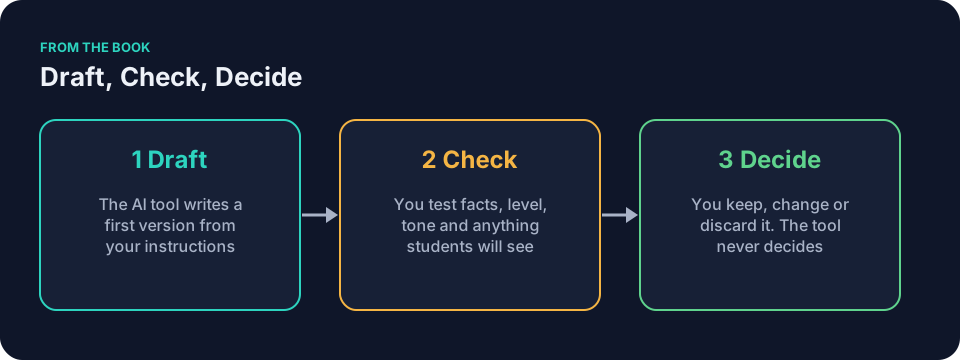
The tool drafts, you check it, you decide. This follows the rule from Using AI for lesson planning without losing the lesson. Start from the teacher’s objective and what students already know, let the tool draft the period, then check timing, level and accuracy before deciding.
Check that meaning survived
With AI for differentiated learning, the check starts with the source’s three or four non-negotiable ideas. For Maya those are the direction of transfer and the fact that cold is not a substance flowing from the ice into the soda. Compare each adapted version against that list sentence by sentence. If a sentence now suggests cold flows from ice into soda, the meaning has shifted. Fix it yourself or request one narrow rewrite.
Original: “When a metal spoon sits in hot soup, thermal energy moves from the soup into the spoon because the soup is warmer.” Version 1 draft: “The spoon gets hot because the soup gives it heat.” Maya reads it twice. The direction is right, warmer to cooler, but “gives it heat” could let a student picture soup handing over a substance.
She rewrites it: “The soup is warmer than the spoon, so thermal energy moves from the soup into the spoon.” She leaves the particle explanation untouched: “Where the warm soup touches the cooler spoon, interactions between particles transfer energy into the spoon.”
Test for misconception with a quick exit-ticket question. “A student says the cold from the ice moved into the soda. What would you tell them?” The answers give Maya a sense of what students can explain. Compare each version with the source and your must-keep facts; check the science independently when needed.
Add vocabulary scaffolding without rewriting everything
Say Version 2 returns with three terms in bold: thermal energy, kinetic energy, transfer. Each carries a one-sentence definition in parentheses on the same line. Maya reads the bolded terms aloud once at the start of class. Students can ignore the definitions or glance at them.
You keep your own voice. You stop editing once the text does the job. The same pattern appears in AI writing tools for teachers: clearer directions, handouts and rubrics. Frank Bell rewrote the same worksheet directions three times.
AI for differentiated learning can put optional definitions beside the terms students need; check that those definitions preserve the source’s meaning. The definitions sit inside the text itself. No separate glossary. No public announcement about who needs them.
Every student receives the same stack of three printed versions. The optional supports appear only in Version 2, inside parentheses on the same line as the bolded term. A student who starts with Version 1 and decides the shorter sentences are enough can ignore the parentheses entirely. A student who begins with Version 2 and later wants the original phrasing can pick up Version 3 from the stack. No one announces which copy belongs to whom.
Create extension tasks for students who are ready
Say the third version adds two questions at the bottom. The first asks: “Your hand feels cold when you touch a metal railing in winter. Using the idea of thermal-energy transfer, explain what is happening between your hand and the railing.” The second asks: “A spoon sits on the counter overnight. In the morning, the spoon and the air around it are the same temperature, so there is no net transfer of thermal energy between them at that moment. What could change to cause transfer again?”
The first question pushes application to a new everyday example. The second pushes reasoning about the conditions that allow transfer. Maya keeps both. They test different depths of the same idea.
These extensions live on the same page as every version. No separate handout. No announcement about who should complete them. Any student who finishes the core reading and wants to keep going can try them. The rest of the class moves to the exit ticket.
Reading-level notes stay in Maya’s private copy. She does not write “grade 6” on any handout. She does not assign versions by name. She prints all three, stacks them on the back table, and lets students pick. Some choose the version with bolded terms because they like the definitions. Others begin with the shorter sentences and switch to the original when they feel ready.
This approach aligns with CAST, Universal Design for Learning Guidelines, which emphasize planning lessons that work for many kinds of learners from the start.
AI for differentiated learning: a worked example in history
Picture a tenth-grade history teacher adapting a two-page excerpt from a fictional 1863 letter written by a Union soldier to his sister. The invented text sits at a high reading level with long sentences and unfamiliar terms such as “emancipation” and “proclamation.”
The teacher pastes the excerpt into the same general AI assistant. She uses a prompt nearly identical to the science one above, only the topic and facts change. She lists the three historical claims that cannot shift: the date of writing, what the author claims he saw, and what the letter does not establish about policy.
Version 1 shortens sentences and replaces two archaic phrases while keeping every claim intact. Version 2 bolds “emancipation,” “proclamation,” and “Union” with one-sentence definitions in parentheses. Version 3 adds two extension questions: one that asks students to connect the letter’s language to a modern speech they have studied, and one that asks them to consider what else the author might have written if his goal had been different.
The teacher checks each version against her list of must-keep claims. Original sentence: “The proclamation declared enslaved people free in designated areas in rebellion; it did not apply to the border states or certain exempted areas.” Version 1 draft: “The order freed enslaved people everywhere.” The draft drops the border-state exception and overstates the scope. She restores the original wording: “The proclamation declared enslaved people free in designated areas in rebellion; it did not apply to the border states or certain exempted areas.”
She checks the letter’s claims separately from historical facts. The letter is a constructed classroom text, not a historical primary source. She verifies the fictional author’s claims against the historical record before deciding what reaches the classroom.
AI for differentiated learning in a sixth-grade math lesson
Picture a sixth-grade teacher with one word problem on rates: “A bus travels 150 miles in 3 hours. A train travels 200 miles in 5 hours. Which one travels faster?” The must-keep facts are the two distances, the two times and the answer. The bus averages 50 miles per hour and the train 40, so the bus is faster.
She pastes the problem into the same prompt and changes the facts list. Version 1 comes back with shorter sentences: “A bus goes 150 miles in 3 hours. A train goes 200 miles in 5 hours. Which is faster?” The numbers survive. Version 2 bolds rate and per hour, each with a short definition in parentheses. Version 3 adds an extension: “The train covers the same 200 miles in 4 hours. Is it faster than the bus now?”
She works the extension before she prints it. 200 divided by 4 is 50, the same as the bus, so the honest answer is that they tie. She keeps the question, because the tie is the interesting part and students who rush will say the train wins.
One draft of Version 1 changes “200 miles” to “about 200 miles.” That one word changes the problem, so she deletes it. When you use AI for differentiated learning in math, the numbers are the facts, and every one of them gets checked against the original before the stack goes on the back table.
Common mistakes and how to fix them
A common mistake with AI for differentiated learning is skipping the list of non-negotiable facts. The tool then drops a key detail or adds an example that contradicts the original. Write the four facts first, paste them into the prompt, and compare every sentence against them.
Another mistake is asking for too many versions at once. The drafts grow long, errors hide, and more versions mean more drafts to check. Start with two versions. Check them. Save the prompt. Add the third version the next evening.
Do not paste a student roster or identifiable exit-ticket responses into an unapproved tool. That crosses into yellow or red territory. Public information is green. Anonymized answers without names are yellow. Identifiable student information must not go into a tool your school has not approved. Removing names alone does not necessarily anonymize student work; follow your school’s policy and ask before sharing yellow material.
The one-page set of norms in Responsible AI in the classroom: a short set of house rules covers disclosure, human review, fact-checking, data protection, fair access, and bias. The author researches bias in multilingual models across English, Hindi, and Bengali, so check wording and meaning in every language you use.
Another error is stamping versions with ability labels. Keep level notes on your working copy only. Let students choose from the stack. When a student asks which one to take, say: “Start with whichever looks right to you. You can switch.”
Questions teachers ask
How do I know the tool did not change the science?
You do not know. That is why you list the required facts and check every sentence against them. The tool predicts likely text. It does not verify truth. The check is yours.
Can I use this for math word problems?
Yes. Replace the science facts with the exact mathematical relationships that must stay untouched. Ask for one version with shorter sentences, one with bolded terms, and one with an extension that asks students to change one variable and predict the new result. Check that the shorter-language versions preserve the original quantities and answer. Check the changed-variable extension separately.
What if the extension questions feel too hard for some students?
Leave them at the bottom of every version. No one is required to reach them. Students who finish early and want more can try them. Others stop at the core text. No labels are needed.
Does this work with a document-grounded tool such as NotebookLM?
It can. If your approved document-grounded tool accepts the reading, ask it to work from that text. Check every adaptation against the original. The prompt stays almost the same. Add one line:
Answer only from the uploaded document: [uploaded reading title].
How many versions should I make?
Two is often enough. Add a third only when the class spread feels wide. More versions multiply the checking time. Start small.
What about bias in the drafts?
For multilingual or culturally specific readings, check terminology, names, and examples against the source; ask a qualified colleague when you cannot check a language yourself. UNESCO, Guidance for generative AI in education and research (2023) offers global guidance on generative AI in education and research. Read every draft yourself. Check for altered claims, missing exceptions, and definitions that introduce a misconception.
How do I keep AI for differentiated learning from labeling students?
Keep level notes on your private copy only. Print all versions without marks. Stack them where students can reach. Let them choose and switch without asking permission.
One lesson, different learners
The chapter One Lesson, Different Learners in Keep It Simple: AI for Teachers covers adapting a single lesson for different learners. The free sample contains the first four chapters if you want to see the approach before deciding.
Next step
Open the article you plan to assign tomorrow. Paste it into your school-approved assistant. Ask for one adapted version using the prompt block above. Read the output before you decide what reaches the classroom.