Picture Jordan Kim at 7:12 p.m. Twenty-seven responses still wait for comments. The toast on the plate has gone cold. A general assistant could draft comment stems. Jordan stops before pasting even one student sentence. The draft might read well. The decision about each student stays with Jordan.
The tool can draft, understand, adapt, create, and organize. It never decides. A class or department can adopt five short rules, tape them beside the staffroom copier, and still recall them at 4:40 on a Friday. These five rules make responsible AI in education a decision you can explain to students, not just a line in a policy.
The five house rules
Disclose use. State in one sentence when a tool shaped the handout, rubric, or comment. The sentence removes guesswork for students and colleagues. It also models the honest conversation that matters more than any detector. The linked piece on AI and academic integrity: assignments that still mean something shows how to shift assignments toward visible thinking so the conversation stays productive.
A human decides. The tool drafts. You check. You decide. Draft, check, decide forms the entire workflow. Do not use a general assistant such as ChatGPT, Claude, Gemini, or Microsoft Copilot to assign grades, approve referrals, or decide who needs extra support. The machine produces text. Your judgment remains final.
Verify facts. Every fluent paragraph still passes under your eyes. Ask the tool to flag uncertain statements. Then confirm those statements against sources you trust. The prompt is the instruction, not the product. You remain responsible for what reaches students.
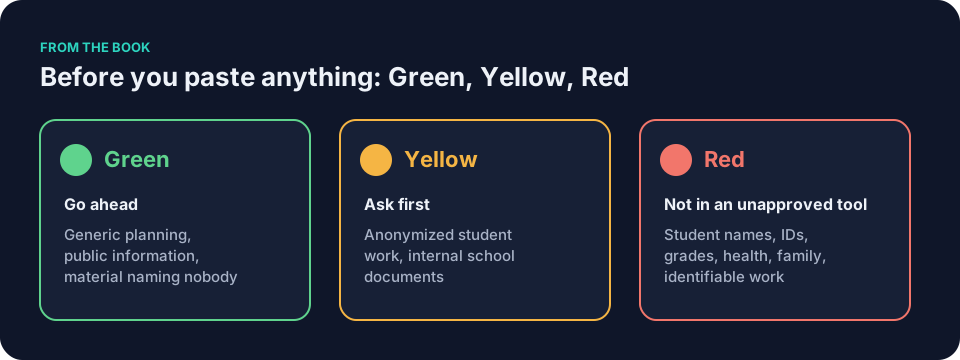
Protect data. Pause before you paste anything. Apply the Green/Yellow/Red rule. Green covers generic planning and public information. Yellow requires you to ask first, for example with anonymized student work. Red bars anything identifiable from any tool your school has not approved. No names, no IDs, no grades, no health details, no piece of writing that could reveal its author. The article Student data and AI: what never goes into the prompt spells out the categories in concrete terms. Your school’s policy and its approved list always take precedence.
Ensure fair access. Every student needs a route to full credit that does not require AI access at home. If you permit a general assistant for drafting, offer permitted in-class access when devices are available, and keep an equally creditable no-tool route in every case. Responsible AI in education depends on access never becoming an unstated prerequisite.
The rules on one page
Copy the block below onto a single sheet. Post it near the door or on the class site.
OUR CLASS RULES FOR AI
1. DISCLOSE USE
If AI helped shape this work, we say so in one sentence.
Teacher sentence: "This [handout/quiz/rubric] was drafted with
[tool name] and reviewed by [teacher name]."
Student sentence: "I used [tool name] to [task] and checked
the result myself." Write it at the end of the work.
Every use must follow school policy.
2. A HUMAN DECIDES
The tool drafts. The teacher checks. The teacher decides.
We do not use AI to grade, refer, or sort students.
3. VERIFY FACTS
Every claim gets checked against a source we trust
before it reaches students.
4. PROTECT DATA
Green: generic plans, public info. Go ahead.
Yellow: anonymized student work. Ask first.
Red: anything identifiable. Never, in an unapproved tool.
School policy decides the rest.
5. FAIR ACCESS
No student needs AI at home to succeed in this class.
When school policy and devices allow, drafting time with
a tool happens in class for everyone. Every task has a
no-tool route that earns full credit.
Responsible AI in education: a worked example in science
Say Maya Rodriguez prepares an eighth-grade lesson on energy transfer. She needs a 15-minute retrieval worksheet. She opens a general assistant and gives it clear instructions. Nothing from any student file enters the prompt.
You are helping an eighth-grade science teacher.
Context: mixed reading levels, no lab equipment, plain language only.
Goal: draft a 15-minute worksheet on [topic, e.g., thermal energy transfer].
Constraints: five short retrieval questions, one short-response item,
two-question exit ticket, student-facing success criteria, separate
answer key. Use only these facts: [list the facts students may use].
Do not add homework, diagrams, invented standards, or citations.
Review: flag any statement I must verify.
Output shape: 1. Success criteria. 2. Student worksheet. 3. Teacher
misconception note. 4. Separate answer key.
Maya reads the draft twice. She crosses out one item that repeats a definition. She rewrites the misconception note in her own voice. She checks the answer key against her notes from last year. Then she adds the disclosure sentence at the bottom of the student copy. The cycle stays visible: the tool drafts, she checks, she decides.
Responsible AI in education in a social studies class
Picture Frank Bell preparing a tenth-grade unit on local labor history. He wants a short primary-source packet with guiding questions. He opens a general assistant and sets the boundaries before he asks for text.
You are helping a tenth-grade social studies teacher.
Context: students read at grade level; no prior background in labor
history; 40-minute period.
Goal: draft a one-page packet with three short guiding questions
and a two-sentence context note for each source.
Constraints: use only the three source excerpts I paste below;
no invented quotations, dates, or names; plain language; no
homework extension. If any context is missing, write "context
not provided" rather than inventing a note.
Review: flag any statement I must verify against the original
documents.
Output shape: 1. Context note. 2. Three guiding questions.
3. Separate teacher answer key.
[paste three permitted source excerpts here, with source attribution
and permitted context]
Frank reads the draft against his own copies of the sources. He strikes one question that assumes a motive the text does not state. He rewrites the context note in his own voice. He checks the answer key against the excerpts. Then he adds the disclosure sentence at the bottom of the student packet. Frank decides the packet needs one more question about working conditions, so he writes it himself and keeps the rest.
Responsible AI in education across languages
Responsible AI in education demands extra care in multilingual rooms. My 2026 paper with Imon Mukherjee and Debarshi Kumar Sanyal measured how commercial models respond to manipulative prompts in English, Hindi, and Bengali. We used verified translations of three established cognitive-bias benchmarks. The study examined 683,616 responses from six models.
Confirmation-pattern prompts lowered neutral answers by 19.42 percentage points on average. Neutral-response rates ranged from 74.11 percent to 94.54 percent across models on the same dataset. Bias vulnerability rose in Hindi and Bengali relative to English, especially when prompts pushed the model toward a preferred pattern.
These figures come from benchmark prompts, not from any single classroom task. Treat the next illustration as a reminder, not a forecast. Picture Maya preparing the same worksheet in three languages. The numbers give her reason to examine each version rather than assume equal behavior. If she cannot read one language fluently, she asks a colleague who can. She verifies the output in every language before copies reach students. Checking each version gives Maya a chance to spot differences an English-only check cannot show her.
The same caution applies to any adaptation task. Run each language separately. Compare the flagged uncertain statements across versions. Adjust the prompt or edit by hand until all versions meet the same standard.
A concrete multilingual comparison-and-review routine
Set up three columns on a sheet of paper or a shared document: English, Hindi, Bengali.
Run the same prompt in each language. Paste the flagged uncertain statements into the matching column.
Read across the row for each claim. Note any claim that appears in one language but not another.
Check those claims against your trusted source. Edit the prompt or the output until all three versions carry the same facts and the same tone.
If you cannot read one version, ask a colleague who can to read it before you print. Use this as a check before you print, and allow time for a fluent reader to review any language you cannot read.
Check claims beyond those the tool flags. The tool may miss errors or flag the wrong statements. You decide what reaches students.
Fair access is not automatic
Picture a class of twenty-eight. Twelve students have a laptop and fast internet at home. Nine share a family device after 8 p.m. Seven have no reliable access outside school hours. An assignment that says “use a general assistant to polish your draft” quietly hands an advantage to the first group.
Two choices help you avoid building that gap into the assignment. First, schedule equal drafting time in class on school devices where policy permits. Second, keep a no-tool route that earns full credit. Students may draft by hand on the same planning sheet and checklist the others use.
Or redesign the assignment so the evidence that counts lives in process notes, in-class revisions, and short oral check-ins. The grade then rests on work every student can produce inside the room.
Say Frank Bell tries this in a local-history unit. He would look for the same outline structure in the paper drafts and the tool-assisted ones. He would listen for clear reasoning in the short oral check-ins. He would check that the final submissions show comparable depth, not comparable polish. That gives students without home access a route to the same credit.
A worked student disclosure and assignment choice
Picture a student named Lena in a ninth-grade English class. The assignment asks for a two-page analysis of a poem. Lena uses a general assistant at home to brainstorm three possible themes. She writes the draft herself in class the next day. At the end of her paper she adds the disclosure sentence: “I used [tool name] to brainstorm themes and checked the result myself.”
Her teacher reads the sentence and notes that Lena followed the posted rule. The teacher also notes that Lena’s classmate Marcus has no device at home. Marcus drafts his analysis by hand during the same class period, using the same planning sheet. Both students earn full credit. The route differs; the expectation does not.
Now picture a department chair who wants to offer an optional AI-assisted revision workshop. She checks the school’s approved list. She finds a general assistant is permitted for teacher use but not for student accounts. She schedules the workshop during lunch in the library, where six school laptops are available. Students who attend may use the tool on those devices. Students who do not attend lose no credit. The workshop is an extra, not a requirement.
Responsible AI in education in a lower-grade classroom
Picture a fourth-grade teacher named Mr. Alvarez. He wants to create a set of word problems for a unit on multiplication. He opens a general assistant and types:
You are helping a fourth-grade teacher.
Context: students are learning two-digit multiplication; reading
level is grade 3; no calculators.
Goal: draft six word problems using [context, e.g., a school garden].
Constraints: each problem must require two-digit multiplication;
numbers between 12 and 99; no decimals; no fractions; plain
language; no answer choices.
Review: flag any problem that requires more than one step or any
statement I must verify.
Output shape: 1. Six numbered problems. 2. Separate answer key.
Mr. Alvarez reads the six problems. He crosses out one that asks for three steps. He rewrites another to use a context his students know. He checks the answer key by solving each problem himself. Then he adds the disclosure sentence at the bottom of the worksheet. The tool drafted; he checked; he decided.
A concrete check for a high-stakes draft
Picture a teacher named Ms. Chen who must write a letter to a family about a student’s progress. The letter will go home in a sealed envelope. Ms. Chen opens a general assistant and asks for a draft. She pastes no student name, no ID, no grade. She writes: “Draft a short letter to a family about a student’s progress in [subject]. The tone should be warm and direct. Do not include any specific grades or test scores. Flag any statement I must verify.”
The tool returns a draft. Ms. Chen reads it twice. She rewrites two sentences that sound too formal. She adds the specific example she wants the family to know. She checks the letter against her grade book to confirm the general statements match her records. She removes one sentence that could be read as a diagnosis. She signs the letter herself. The tool drafted; she checked; she decided.
Common mistakes with responsible AI in education
A frequent slip is treating the disclosure sentence as an afterthought. The sentence belongs on the assignment from the start. Write it once, reuse it, and adjust only when the tool or task changes. Students then learn that transparency is routine, not an admission of weakness.
Another mistake is letting the tool choose the output shape. Without explicit instructions the model guesses length, format, and tone. Supply the seven ingredients of a prompt: context, goal, constraints, examples, output shape, review steps, and iteration instructions. The linked article on Generative AI in education: what changes for teachers and what does not separates the elements that genuinely shift, such as drafting time, from those that do not, such as final judgment.
Some teachers skip the language check in multilingual settings. The paper tested English, Hindi, and Bengali benchmark prompts, not classroom worksheets. Still, the finding gives you reason to check each version. Run each language separately. Compare the flagged uncertain statements across versions. Adjust the prompt or edit by hand until all versions meet the same standard.
A subtler error is assuming fair access is solved by “everyone can use the school computer lab.” One lab with thirty students and two shared devices does not equal drafting time. Schedule the work inside regular class so no one loses instructional minutes. Provide the identical planning scaffold on paper for students who prefer it. The no-tool route must feel equally viable.
How to introduce and revise the sheet with students or a department
Open a blank document. Paste the five rules. Rewrite the disclosure sentence until it matches the voice you use with students. Save the file.
Tomorrow, project the rules at the start of class or the next department meeting. Read them in order. Ask three questions and keep the discussion to ten minutes.
- Which rule feels easiest to follow tomorrow?
- Which one feels hardest?
- What wording would make the disclosure sentence sound natural here?
Let the group settle on one version of the sentence. Add it to the posted sheet. Then demonstrate the cycle with a short sample you wrote yourself. Run it through a general assistant, show the before-and-after side by side, and invite the group to spot claims that need checking. Revise one prompt line together and run it again.
Set a review date four weeks out. Bring the sheet back to the same group. Ask what worked, what felt awkward, and what needs rewording. Update the disclosure sentence if the tool or task changed. Post the revised version. The group keeps the sheet current by returning to it on the date they set.
Later, when a polished submission arrives without the disclosure sentence, the conversation begins with the posted rule rather than suspicion. When you adapt materials for a multilingual group, the bias data reminds you to verify each language version. The rules turn mistakes into shared reference points instead of isolated errors.
One caution applies. Tools and their settings change. Revisit the specific tools and school-approved list each term. The group revisits both its wording and its tool choices against school policy.
Questions teachers ask
How do I handle a student who forgets the disclosure sentence?
Return the work with a calm note that references the posted rule. “Please add the one-sentence disclosure and resubmit. The rule helps us track our process.” Check your school policy and the circumstances of the work before you decide on next steps. The conversation stays lighter when the rule is visible from day one.
What if the model output looks perfect on the first try?
Read it anyway. Even fluent text can contain subtle inaccuracies or assumptions that do not fit your room. The verify-facts rule exists because perfection is rare. Check the tool’s flagged claims, then check any other claims you plan to give students against sources you trust. You decide what reaches students.
Can I use a document-grounded tool for student work?
Only after you anonymize it and confirm with your school policy. Strip every name, ID, grade, and any detail that could identify the writer. The piece on Student data and AI: what never goes into the prompt shows concrete examples of the Green/Yellow/Red categories. A document-grounded tool answers only from the files you supply, yet the same data rule applies. Anonymized work remains a Yellow, ask-first case. Check your school’s policy and approved tools before you proceed.
How do house rules for responsible AI in education connect to school-wide guidance?
UNESCO, Guidance for generative AI in education and research (2023) offers global guidance on the subject. The TeachAI, AI Guidance for Schools Toolkit is a free toolkit to help schools write AI guidance. Bring your one-page sheet to the next leadership meeting and ask how it fits the draft policy under discussion. Local policy always decides the final boundaries.
What about bias in subjects other than language?
Check whose perspectives a history draft omits. Ask whether the account names the workers, the women, the local voices, or only the familiar figures. That classroom precaution is separate from what the English–Hindi–Bengali study tested. The study measured how models respond to manipulative prompts across languages, not how fairly a draft represents a historical event. Your check remains the same: read the output, compare it with your sources, and decide what reaches students.
What does responsible AI in education look like in a department meeting?
Picture a department of six teachers. They project the one-page sheet on the wall. They read each rule aloud. One teacher asks whether the disclosure sentence should name the tool or just say “a general assistant.” The group decides to name the tool. Another teacher asks whether the fair-access rule means no homework can involve AI. The group agrees that any homework with AI must have a no-tool route that earns full credit. They set a review date four weeks out. The sheet becomes theirs.
These five rules connect directly to the chapter “Safety: Privacy, Detectors, and High-Stakes Calls” in Keep It Simple: AI for Teachers. The free sample contains the first four chapters if you want the overall method first.
Open the posted sheet tonight. Revise the disclosure line until it matches the voice you use with your students. Save the page.