Picture Maya Rodriguez at 7:12 p.m. She stares at tomorrow’s eighth-grade energy-transfer lesson. The objective sits clear in her head. Students must explain that the net transfer of thermal energy is from warmer objects to cooler ones. A fill-in-the-blank worksheet that asks them to copy vocabulary terms will not show whether they understand the direction of transfer.
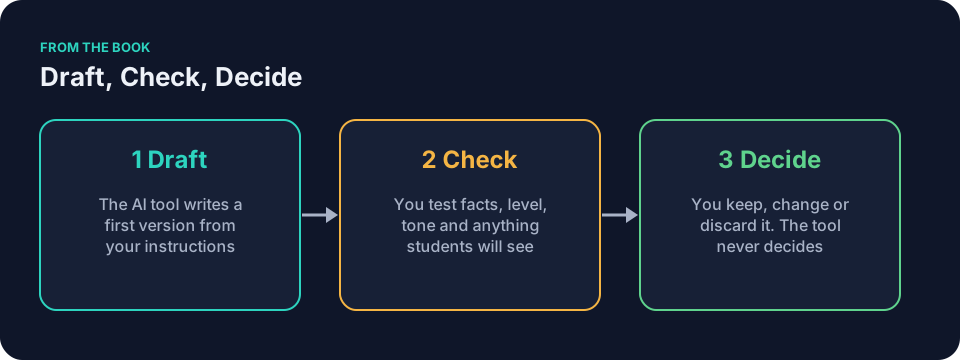
She needs them talking, sorting, arguing, and showing what they understand while time remains to fix errors. You can ask a general AI assistant to draft those activities. The tool drafts, you check it, you decide. Nothing reaches students until you have read it against your objective, the facts they have already learned, and the physical space you share with thirty bodies.
This is how AI for classroom activities stays useful. It supplies first versions of tasks that require movement and talk. The final call belongs to you.
Five activity types that get students talking and moving
Sorting tasks ask students to group examples under headings you choose. Picture Maya’s class with slips of paper that describe a warm spoon placed in cool water or the false claim that cold moves from the water into the spoon. Students walk to labeled corners of the room and defend why each example belongs under “thermal energy moves from warmer to cooler” or “common misconception.” They explain their placement out loud. Those explanations expose who still thinks cold travels like a substance.
Role plays turn abstract ideas into short scenes. Four students might act out energy moving from a warmer mug into a cooler hand. They do not pretend to be particles traveling between the two. They show the direction of transfer with their bodies. The rest of the class watches and notes which actions match the science they have studied. The scene lasts two minutes. The debrief lasts ten.
Discussion prompts give every student a sentence starter or a single debatable claim. “Cold is a thing that moves from ice into lemonade” works better than a generic “discuss energy.” Students first write for one minute, then turn and talk, then join a larger circle. The prompt forces them to take a side before the first voice dominates.
Exit tickets close the period with evidence you can read after the final bell. A two-question version might ask one retrieval item and one short explanation: “Show one place in today’s role play where energy moved from warmer to cooler. Use the word particle at least once.” You collect the slips on the way out and see the pattern before tomorrow’s opener.
Quick polls ask students to commit to a claim before any talk begins. They stand on one side of the room for agree and the other for disagree. The visible split surfaces misconceptions early. Maya uses this when she wants to see who still thinks cold moves like a substance before the role play begins.
How to ask for variety in AI for classroom activities
Open a general assistant such as ChatGPT, Claude, Gemini or Microsoft Copilot. Tools and their settings change, so check what your school has approved this year. Begin with the objective and the content already covered. Then list the activity types you want to see.
The seven ingredients of a prompt keep the output narrow enough to check. Context names the grade, the topic, the exact objective, the facts students already know, the room layout, and the reading range. Goal states the single job. Constraints list what the tool must not add. Examples show the voice and depth you want. Output shape tells the tool exactly how to format each activity. Review asks it to flag anything that drifts from the objective. Iteration means you quote the weak part and ask for one fix.
Before you paste anything, run the Green, Yellow, Red check. Green means go ahead: generic planning, public information, and objectives you would say out loud in a staff meeting. Yellow means ask first: anonymized student work, class notes with names removed, or anything that touches individual learners. Red means stop: do not paste student work into a tool your school has not approved, and do not assume that removing a name makes it safe. Check your school’s policy before you upload anything.
Try this prompt as a reusable template.
You are helping a [grade] teacher plan a [class time] lesson.
Context: Topic is [topic]. Students already know [prior knowledge]. The exact objective is [objective]. Reading range is [reading range]. Room constraints are [room constraints].
Goal: Draft five different student-facing activities that require talking or moving. One sorting task, one role play, one discussion prompt set, one exit ticket, one quick poll. Each activity must test the objective above.
Constraints: No worksheets that students simply fill out alone. No homework. No invented standards. Use plain language. Keep each activity to ten minutes or less. Include clear directions students can read themselves. Provide one likely misconception the teacher should watch for.
Example of the depth I want: [example of a good activity or a student direction you like].
Output shape:
- Activity name
- Materials needed (if any)
- Student directions
- Teacher notes on what success looks like
- One common student error to notice
Review: Flag any activity that does not clearly test the objective. Suggest one small change that would add physical movement if the first version is mostly seated.
After drafting, wait for my revision requests.
Here is the same prompt filled in for Maya’s energy-transfer lesson.
You are helping an eighth-grade science teacher plan a 45-minute lesson.
Context: Topic is thermal energy transfer. Students know that thermal energy moves from warmer objects to cooler ones, that cold is not a substance that moves, and that when a substance warms without changing state, its particles move faster on average. Mixed reading levels. Ordinary classroom with movable desks, no lab equipment.
Goal: Draft five different student-facing activities that require talking or moving. One sorting task, one role play, one discussion prompt set, one exit ticket, one quick poll. Each activity must test the objective above.
Constraints: No worksheets that students simply fill out alone. No homework. No invented standards. Use plain language. Keep each activity to ten minutes or less. Include clear directions students can read themselves. Provide one likely misconception the teacher should watch for.
Example of the depth I want: A role play where four students act out energy moving from a warm mug into a cooler hand, showing direction with their bodies, while the class notes which actions match the science.
Output shape:
- Activity name
- Materials needed (if any)
- Student directions
- Teacher notes on what success looks like
- One common student error to notice
Review: Flag any activity that does not clearly test the objective. Suggest one small change that would add physical movement if the first version is mostly seated.
After drafting, wait for my revision requests.
The five drafts are options, not a script for one period. Maya will run one or two tomorrow and save the rest. The role play with its two-minute scene and ten-minute debrief already fills twelve minutes of the period.
Change the activity types when you want different slices of the same objective. If you need more than one version of the role play, ask for it like this.
Give me two versions of the role play: one for early finishers and one for students who need more support. Keep both within [time limit] and testing the same objective: [objective].
Check whether the drafts actually differ and still test the objective. You still read every line.
Save the prompt once it produces something close. Next week you can swap the topic and the facts without rewriting the whole block. The prompt is the instruction, not the product.
This habit echoes the same approach in Using AI for lesson planning without losing the lesson. Start from the teacher’s objective and what students already know. Let the tool draft the period. Then check timing, level, and accuracy before deciding.
What to check before you run any activity
Read the draft against three questions. Does the science match the trusted source you keep on your desk? Does the activity actually require students to use the exact objective, or does it drift into recall of vocabulary alone? Will it work in your room with the furniture and the time you have?
If a draft asks students to role-play “cold moving,” cross that direction out and have them show energy leaving the warmer object. If the exit ticket can be answered in one word, rewrite it until it produces evidence you can actually read at your desk after the final bell.
Check timing by setting a timer and walking through the directions yourself. Check reading load by reading the student version aloud. Check safety by asking whether any role play could embarrass a quiet student. If the activity fails any of these, revise it or discard it.
The same review habit appears in AI for assessment: better questions in less time when you build better distractors that reveal thinking and ask for a separate answer key. You still check every item. The same care shows up in AI for differentiated instruction: one lesson, several ways in when you adjust one reading for different entry points. The check that matters is whether the meaning survived the simplification. Avoid anything that labels students.
You can also ground the draft in a trusted document. A document-grounded tool such as NotebookLM answers only from the files you give it. Teacher-specific tools such as MagicSchool or Brisk offer ready-made templates for common classroom tasks. You still check each draft against your objective and your room.
Common mistakes with AI for classroom activities and how to fix them
A common mistake with AI for classroom activities is to paste only the topic and hope. The tool guesses the grade level, the prior knowledge, the time limit, and the exact objective. A polished draft can still test the wrong thing. Fix it by feeding the seven ingredients listed earlier. That added context prevents the tool from having to guess what your students already know and what your room allows.
Another mistake is to accept the first draft without a timer test. A ten-minute estimate may leave out directions, movement, and cleanup. Walk through the student directions at your own pace before class. Adjust or drop what runs long.
Some drafts include activities that sound interactive but remain seated. The quick poll that asks for a raised hand instead of a walk across the room is one example. The review instruction asks the tool to flag these; check the activities yourself. When it misses one, add the physical move yourself.
With AI for classroom activities, reject a poll that asks students to guess; ask for a claim they must defend instead.
AI for classroom activities: checking a social studies sort
Say Frank Bell, a veteran social studies teacher, wants to try AI for classroom activities in a lesson on the causes of the American Revolution. His objective is that students explain how economic pressure, political ideas, and local events combined to push colonists toward independence. He wants them to weigh which factor mattered most on a given day.
He pastes the objective, the three factors already discussed, the reading levels in the room, and the movable desks into the prompt above. He changes the topic and the facts. The tool returns a sorting task that gives students ten events and asks them to place each under one primary cause. Students must defend their choices in pairs, then regroup when Frank calls a new factor.
Here is what a complete sort might look like after Frank checks it.
Sorting task: Causes of the American Revolution
Headings:
- Economic pressure
- Political ideas
- Local events
Cards:
1. The Stamp Act requires tax stamps on many printed materials and legal documents.
2. Colonists read pamphlets about natural rights.
3. British soldiers fire into a crowd in Boston.
4. Merchants boycott British tea.
5. A colonial governor dissolves the elected assembly after it protests a tax. (Hypothetical scenario for discussion.)
6. A local committee of correspondence forms.
7. New taxes on glass and paint arrive.
8. Speeches in Virginia argue for independence.
9. A tea ship is turned away from the harbor.
10. Colonists destroy tea in Boston Harbor.
Answer key for the teacher:
1. Economic pressure. The Stamp Act placed a tax on many printed materials and legal documents.
2. Political ideas. The pamphlets spread arguments about rights and representation.
3. Local events. The shooting happened in Boston and inflamed local opinion.
4. Economic pressure. Boycotting British tea was one way colonists protested British taxation and trade policy.
5. Local events or political ideas. The scenario is invented, but it mirrors real disputes. Accept either placement if the student explains how the conflict connects to representation.
6. Local events. The committee organized resistance; students should explain how it also spread political ideas.
7. Economic pressure. The Townshend duties taxed imported goods such as glass and paint.
8. Political ideas. The speeches made arguments about liberty and self-government.
9. Local events. The ship’s return was a local act of resistance; students should explain its link to economic protest.
10. Economic pressure and local events. The destruction of the tea was a protest against the tax and a dramatic local event.
Frank reads every line against his trusted timeline. He notices that card 10, the Boston Tea Party, could sit under economic pressure or local events. He keeps the card as written and adds a note to the teacher key: “Accept either placement if the student explains how the tax protest connects to the event.” He also rewrites the exit ticket so it cannot be answered with a single name.
The role play shows a merchant in Boston arguing with a British tax collector. Four students rotate through the roles while the class notes which economic pressure appears in each line. The discussion prompt reads, “The Stamp Act mattered more than the Boston Massacre because…” Students write first, talk second.
The exit ticket asks them to pick one event from the sorting task and write one sentence that uses the word “combined” to show how two causes met. The quick poll splits the room into three corners labeled with the three factors. Students stand in the corner that matches the event Frank reads. They explain their move.
Frank will run the sorting task tomorrow. He will collect the exit tickets and look for the word “combined” used correctly. If half the class still treats the causes as separate boxes, he will repeat the quick poll the next day with new events.
A worked revision: fixing a weak AI-generated activity
The tool returns a discussion prompt for Maya’s energy-transfer lesson. The original direction reads: “Discuss with your partner how heat moves.” The prompt is too broad. It does not force students to confront the misconception that cold moves like a substance.
Maya revises it. “Your partner says cold moves from ice into lemonade. Agree or disagree. Use the word particle. Then switch roles.” She adds a constraint: each student must point to one moment in the role play where energy moved from warmer to cooler.
She will listen for the word particle used correctly. She will watch for students who gesture from the cooler object to the warmer one. If she hears “cold moves,” she will ask the pair to act out the transfer again with their bodies.
A second subject-and-age example: elementary math
Say a third-grade teacher plans a lesson on rounding to the nearest ten. The objective is that students explain why 47 rounds to 50, not 40. The tool drafts a sorting task with number cards and two corners of the room labeled “rounds to 40” and “rounds to 50.”
The teacher checks the cards. She notices that 45 sits exactly halfway. She removes 45 and replaces it with 43, which rounds to 40 under the usual classroom rule. She changes the quick poll so students stand on a number line taped to the floor instead of raising hands.
The exit ticket asks students to write one sentence: “47 rounds to 50 because…” She will look for the phrase “closer to” or “five or more.” If a student writes only “because it is,” she will know the explanation is missing.
A short checklist for setup, transitions, and a fallback
Before class, check three things. First, setup: are the cards, corners, or props ready, and do students know where to go? Second, transitions: what signal will you use to move from one activity to the next, and how will you regroup if the first grouping fails? Third, fallback: what will you do if the activity stalls or the room cannot handle the movement?
Write the fallback on a sticky note and keep it in your pocket. For the sort, Frank can have pairs defend one card at their desks instead. If the role play stalls, narrate the scene yourself while students hold up signs.
What a weak exit ticket answer reveals
Say Maya runs the exit ticket from her energy-transfer lesson. One student writes, “The mug got cold because the cold went into it.” That answer tells her the student still thinks cold is a substance that moves. The activity did its job. It exposed the misconception.
The problem is the question. “Show one place in today’s role play where energy moved from warmer to cooler” lets a student repeat a phrase without showing understanding. Maya revises it for tomorrow. “In today’s role play, the mug lost energy to the hand. Explain in your own words why the hand did not give cold to the mug. Use the word particle.” Now the student must confront the misconception directly.
When you use AI for classroom activities, ask the tool to predict the two most likely wrong answers for each exit ticket. Then check whether the question would let those wrong answers pass. If it would, tighten the prompt.
A fallback for a room where students cannot move safely
Sometimes the room is too crowded, the desks are bolted down, or a student needs to stay seated. You can still run the sort. Give each pair a set of cards and a sheet of paper divided into three columns. They sort at their desks and write one sentence defending their hardest placement. You walk the room and listen.
The role play becomes a narrated scene. One student reads the script while three others hold up signs that say “warmer,” “cooler,” and “energy moves this way.” The class still watches for the direction of transfer. The discussion prompt and exit ticket work exactly as written.
AI for classroom activities should bend to the room you have, not the room the tool imagines.
When the old worksheet is still the right choice
Not every objective needs movement. Sometimes you need quiet individual evidence that a student can apply a procedure without peer help. A worksheet that students complete alone can reveal gaps the loudest voices in a discussion might hide.
Say Frank Bell gives students a short worksheet to practice mapping a timeline before they debate causes in groups. The paper becomes the record he can scan while they talk. He reaches for the worksheet when the goal is deliberate practice, not public explanation.
Choose the worksheet when the room is too crowded for safe movement, when half the class is absent, or when the next day’s lab requires individual fluency first. The tool can draft that worksheet too, but the decision stays with you.
The book Keep It Simple: AI for Teachers includes a chapter called Make the Lesson Interactive, which connects to choosing and checking activity drafts.
Questions teachers ask
How do I keep AI for classroom activities aligned with my school’s curriculum?
Feed the tool only the facts and objectives your district has already approved. List them in the Context section. Check every line against your own materials. OpenAI, Teaching with AI is an educator guide with example prompts.
Can a document-grounded tool replace the general assistant for this work?
You can ask it to work from a specific textbook or unit plan, then verify each suggestion against that material. Upload the chapter or your own notes after you check your school’s policy. Check each answer against the document you supplied. If the tool quotes a page, open that page and read it yourself.
What if the activity flops in the first five minutes?
Keep a two-minute fallback ready. If the activity stalls, switch to a two-minute turn-and-talk using the same question. Note what broke so the next prompt can name that constraint.
Does this approach fit Universal Design for Learning?
It can. CAST, Universal Design for Learning Guidelines is a framework for planning lessons that work for many kinds of learners. A sorting task, a role play, and a written exit ticket give students different ways to show the same understanding. You still verify that each path tests the same objective.
How do I start with AI for classroom activities tonight?
Pick one low-risk task. Use the template prompt above with tomorrow’s objective. Read the draft, change one activity that misses the mark, and print the version you will actually use.