Say Jordan Kim sits at the kitchen table at 7:12 p.m. on a Tuesday. Twenty-six other student responses wait in the folder. A cold cup of coffee sits beside the laptop. The school’s AI detector has returned a high score on one essay, and Jordan keeps rereading the paragraph where the argument shifts into a tone this student has never used in class.
That shift is a reason to ask the student about the work. It is not, on its own, evidence of misconduct. AI detectors can be wrong about authorship, and the costs of a wrong call land on a child. When you suspect AI use, the first move is not another scan. It is pointing to a specific passage and asking the student to walk you through it.
To see why the score cannot carry more weight than that, it helps to look at what the tool is actually doing when it reads an essay.
How AI detectors guess
AI detectors estimate whether a piece of text resembles writing they associate with machine generation. That is the whole claim. AI detectors cannot establish who wrote a particular assignment, because they never saw the writing happen. They do not know the student, the assignment, or how the draft came to be.
So a score is a statement about text, not a statement about a person. A cautious student who revises every sentence into smooth, formal prose can produce writing that looks like what a detector expects from a machine. The study below found false positives in essays by non-native English writers.
OpenAI introduced an AI-text classifier and later withdrew it. The OpenAI, New AI classifier for indicating AI-written text announcement was updated to note the tool is no longer available. OpenAI withdrew its own classifier in July 2023, citing its low rate of accuracy. That withdrawal is one concrete illustration of why a detector score should not be treated as proof.
A high score might prompt a closer look at one piece of work. The same score could come from a student who pasted the prompt into a general assistant such as ChatGPT, Claude, Gemini or Microsoft Copilot. It could also come from a student who wrote every word. Tools and their settings change, so anything specific said about one detector today may not hold next semester. The teacher still checks.
False positives and who they hit
A 2023 Stanford-led study offers one concrete warning about false positives. In Liang et al. (2023), GPT detectors are biased against non-native English writers, published in Patterns, the researchers found that popular GPT detectors flagged more than half of the tested essays written by non-native English speakers as AI-generated.
The essays were human-written, and the detectors called them machine-written most of the time. The study tested essays, not live classrooms, so it does not give you a misidentification rate for your own students. It also tested non-native English writing specifically, so be careful not to stretch it into language-by-language claims about Hindi, Bengali, Spanish or anything else.
The study documented false positives in essays by non-native English writers. A widely used kind of tool misread a real group of writers at a rate that should change how much weight any score can carry. Picture a class with several students who write in English as an additional language. If their essays trigger flags, the flag cannot establish whether any one of those students used AI.
Say Frank Bell, a veteran social studies teacher, brings Jordan a stack of short responses from his tenth-grade class. Several carry high scores, and Frank notices that the flagged writers include students he watched draft the work at their desks. Here, AI detectors conflict with something Frank saw: the students drafting at their desks.
Frank’s move is not to trust the room over the software as a general rule. It is to notice that the software and the room disagree, which means the software cannot be the last word. Before he responds to anyone, Frank checks the stated rule on his assignment sheet and the school’s academic integrity policy.
A common mistake with AI detectors
Pasting a full student essay into a detector and treating its percentage as decisive skips the evidence. It also creates a second problem that has nothing to do with accuracy: you may have just put an identifiable child’s work into a tool your school has not approved.
Before you paste anything into any tool, run the color check. Green means go ahead: generic planning, public information, nothing tied to a student. Yellow means ask first: anonymized student work, internal documents, anything where a wrong answer would matter. Red means stop: student names, grades, full identifiable essays, or anything that could identify a specific child does not go into a tool your school has not approved. If you are unsure, treat it as yellow and ask your administrator.
Jordan could skip the public detector altogether. If the school has approved a specific tool, any check happens inside that approval, with the minimum text needed and no identifying details attached. If the school has not approved one, the review proceeds without a scan at all, using the steps in the next section. Either way, the student’s work stays inside the school’s policy.
What to do when you suspect AI use
Start with the work itself, against what you already have. Read the piece next to the student’s earlier writing from your class. Does the voice stay consistent? Does the argument build on ideas that came up in class discussion? Are the examples tied to something the student could actually know?
Then check the assignment’s stated rules about AI. Did you tell students which tools were allowed and which were not? Did you ask for process evidence such as drafts, notes or an outline? This step matters because it sets the terms of everything that follows.
Do not treat drafts you never requested as required proof. If the assignment sheet never asked for drafts, the absence of drafts is not suspicious. What you can do is invite the student to share any drafts or notes they already have, and treat their existence or absence as neutral information, not proof either way. Check your school’s policy before taking further action.
If concerns remain after that, invite a calm conversation. Tie every question to the draft and to the student’s prior work. Three openers that stay on the work:
Walk me through how you developed this thesis.
This paragraph takes a different approach from your earlier draft. Can you tell me about that change?
What sources did you use for this section?
The conversation adds context a score cannot supply, and it cuts both ways. A fluent explanation does not prove authorship. Difficulty explaining does not prove misuse. Some students freeze when a teacher questions their work, including students who wrote every word. Others talk smoothly about work they did not do. Weigh the exchange as one piece of information alongside everything else.
A student might offer an explanation you had not considered. She worked through a thesaurus to vary her word choice because a friend suggested it. He copied the outline structure from the school library guide. Both accounts are plausible, and both would produce a voice shift without any misconduct. The point of asking is to find out which world you are in before you act.
A short conference script
If you have never run this conversation, it helps to have the shape of it in front of you. Keep it to ten minutes, in a private corner of the room or a free period, with the work on the table between you.
Open with the work, not the accusation. Then move through three beats: process, specifics, sources. Close the same way regardless of what you heard. You are gathering information, not extracting a confession. The student should leave knowing the next step, and the next step should be the one your policy describes.
Here is a script you can adapt:
I want to understand how this piece came together, because parts of it read differently from your earlier writing.
Tell me how you started. What did the first draft look like?
[Point to one passage.] What were you trying to do here?
What did you read or use while you worked on this section?
Thanks for walking me through it. I'm going to look at this alongside your earlier work and follow up if I need to.
Draft, check, decide when you review student work
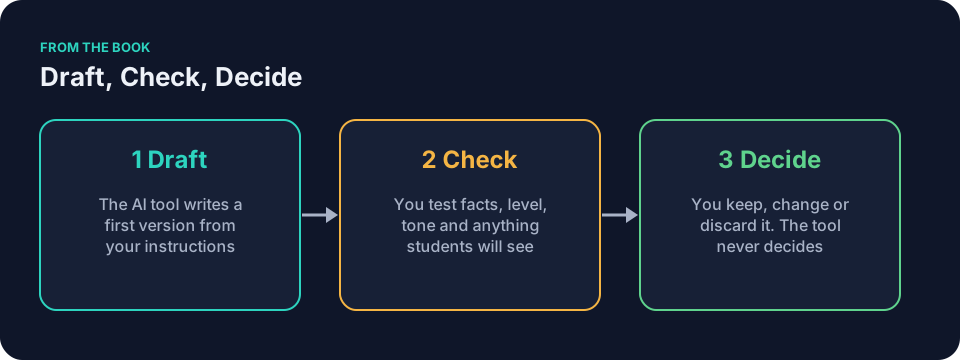
The same three moves that govern AI use in planning govern the review of student work. If you use a tool at all, it can draft: a list of neutral conference questions, a summary of the assignment’s stated rules, a checklist of what process evidence exists. You check that output against your knowledge of the student and the assignment. You decide what happens next.
If you use AI detectors at all, treat their output as a claim to check, never a decision. The teacher decides, working inside the school’s policy.
Here is a prompt that stays on the right side of the line. It asks for neutral conference questions using generic assignment rules, with no student work and no identifying details pasted anywhere:
You are helping a teacher prepare for a conversation with a student about authorship concerns. Do not accuse anyone of anything.
Context: I teach [subject] to [grade level]. The assignment asked students to [task in one sentence].
Stated AI rule on the assignment sheet: [exact rule as written, or "no rule was stated"].
What I can share: a neutral description of my concern, such as [e.g., "the tone shifts in one section" or "the examples are more generic than the student's usual work"]. No student text is included.
Task: Draft 6 neutral, open questions I could ask the student about how the work was made. Each question must invite the student to describe their process, must not assume AI use, and must be answerable whether or not any tool was used. Then list 3 things I should listen for in the answers that would help me understand the process better.
Check the questions it gives you. Cut any that sound like a cross-examination. Keep the ones you could ask with a straight face to a student who did nothing wrong, because some of the students you ask will have done nothing wrong.
A fair process that follows school policy
From the first moment of concern, your school’s academic integrity policy is the map. Check it for any documentation, notification and next-step requirements before you act, and do not improvise consequences based on a detector score. Policies differ between schools, so nothing here substitutes for reading yours.
A workable sequence looks like this. Note the date and the specific concern in writing, in plain language: which passages, what shifted, what the detector said if one was run. Save a copy of the work as submitted. Pull what already exists in your folder: earlier drafts if the assignment collected them, in-class writing samples, lab notes, reading responses. You are assembling what is already available, not demanding new proof.
A neutral documentation note can be three sentences long:
[Date]. Reviewed [student initials]'s [assignment name] after noticing [specific observation, e.g., "a tone shift in the final two paragraphs"]. Compared it with [earlier work reviewed, e.g., "the October in-class draft"]. Held a brief conference on [date]; next step per policy is [e.g., "none — matter closed" or "referral to department chair"].
Then schedule a short meeting in a low-stakes setting, a free period rather than a public moment. Point to the first passage and ask the student to explain how the argument developed. The student may describe an outline, show earlier notes on a phone, or walk through a revision decision made at home. Listen for process, not performance.
After the conversation, you have more information than you did before. The account may line up with the visible work, and you close the matter with a note in your records. Questions may remain, and you check the policy for the documented next step, which might involve a department chair or a dean. Or the student may describe use that broke the assignment’s stated rule, and the policy, not your frustration, determines the response.
If your policy calls for a revision, a reflection, or another instructional response, follow that process. The teacher’s job is to keep every action inside the documented sequence so the student experiences a process, not a verdict.
Fair access belongs in this review too. Students have different access to tools at home, and the assignment itself may have left expectations unclear. AI detectors cannot tell you what access a student had at home or which rules were clear. The process you follow has to account for both.
After the conference: a neutral follow-up
Say Jordan holds the conference and the student explains the work reasonably well, but one section still sits oddly. Jordan does not have enough to refer the matter, and does not want to close it on a hunch either. The neutral follow-up is a short, low-stakes writing check that belongs to ordinary teaching rather than discipline.
A week later, Jordan gives the whole class a brief in-class writing task on the same topic, framed as review. Fifteen minutes, by hand, no announcement that it connects to anyone’s essay. Every student does it, so no one is singled out.
Jordan now has a fresh sample of the student’s unaided writing to read beside the flagged essay. The new piece shows what the student can explain and do now. It is not an authorship test, and a gap between the two pieces does not show how the earlier essay was made. Any referral depends on the school’s policy and the full record, not on this comparison alone.
When the assignment stated no AI rule
Say Jordan reads a strong essay, runs it through the school’s approved detector, gets a high score, and then realizes the assignment sheet never mentioned AI at all. The assignment sheet did not say which tools were allowed or forbidden; Jordan checks the school’s policy. No drafts were requested.
The honest position is uncomfortable: the assignment sheet gives you no AI-use rule to point to. You cannot treat the missing assignment-specific rule as though you gave it. Check whether school policy states another applicable rule before deciding what follows.
What Jordan can still do is legitimate and worth doing. Hold the same conversation, framed as teaching rather than enforcement: “Your piece raised ideas I want to hear more about. Walk me through how you built the argument.” If the student can discuss the work, the conversation becomes instruction. If the student cannot discuss any of it, that is information about learning, not proof of a policy violation.
Then Jordan fixes the actual problem, which is the assignment sheet. The next version states which tools, if any, are allowed, and what process evidence will be collected. Handle the current essay under the rules and school policy already in place; make the next assignment sheet clearer. Anything else is punishing a student for the teacher’s omission.
Assignments that make detection less necessary
Watching students develop an assignment gives you process evidence a detector score cannot. Collecting process evidence gives you more to discuss with a student than a detector score does.
The related piece on AI and academic integrity: assignments that still mean something lays out the redesign. Collect drafts, do some writing in class, add short oral check-ins, and anchor tasks in local or personal context so there is something specific to discuss and check. State the AI-use rule on the assignment sheet and discuss it before students begin.
One concrete version works across subjects. Replace the single final product with three checkpoints: an outline turned in on paper, a draft paragraph written by hand in class, and a two-minute conversation about the thesis during a work period.
The tradeoff is real, because collecting checkpoints takes some planning even when you do not grade every draft. Keep the checkpoints brief and ungraded, or graded for completion only. Those checkpoints give you specific work to discuss if a question comes up, and they help every student, not just the ones you might have flagged.
When process evidence is missing, because the assignment is old or the unit is already underway, do not retrofit requirements onto submitted work. Note the gap for next time, and handle any current concern through the conversation and policy steps above. The fix for thin evidence is a better assignment sheet next semester, not a harsher reading of this semester’s work.
House rules that prevent the hard cases
Suspicion is a bad place to build norms from. A short set of class rules, agreed before any incident, gives students and teachers a shared reference when questions arise. The one-page set in Responsible AI in the classroom: a short set of house rules covers the basics: disclose tool use, a human decides, verify facts, protect private data, and mind fair access.
The house rules also ask teachers to stay alert to the ways tools can treat students unevenly. On AI detectors specifically, the evidence to lean on remains the Liang study linked above. It documented false positives in essays by non-native English writers. The right response is a process that does not rest on a score.
Put the time into questions, not scans
The hours a teacher might spend running scans and disputing percentages are better spent on the assessment itself. A general assistant can draft questions that target a specific misconception, suggest distractors that reveal how students are thinking, and produce a separate answer key you then verify line by line. It should not make grading decisions, and it should not make authorship decisions. Both stay with you.
The walkthrough is in AI for assessment: better questions in less time. Give the tool your trusted content, ask for items aimed at one misconception, request the key separately, then check every item yourself before it reaches a student.
Picture Maya Rodriguez, an eighth-grade science teacher, trying this for a unit on energy transfer. She pastes her own notes, no student work, into a document-grounded tool such as NotebookLM, working from the documents she gives it. She asks for retrieval questions, one short-response item, and an exit ticket aimed at the misconception that energy is used up.
She checks every generated item against her notes. She corrects two statements, cuts a duplicate, and adds a distractor that matches an error she sees every year. The handwritten responses that come back tell her who has the concept and who is still shaky, with no detector run anywhere in the loop.
AI detectors: a worked example in middle school science
Picture Maya reviewing a 400-word explanation of photosynthesis. The school’s approved detector gives it a high score. The vocabulary from the unit is used correctly, but the examples feel generic, and there is no mention of the leaf-disk investigation the class ran two weeks earlier.
Maya opens the folder with the student’s earlier lab notes. The sentence patterns in the notes and the final piece share a structure, though the final piece is far more polished. At a brief conference, Maya asks the student how the floating disks worked as an indicator in that investigation. The student explains that the disks sank at first and rose as the leaf produced oxygen, and that the class timed how long the rise took under different light conditions. That observation never made it into the submitted piece.
Maya now has something a score could not give her: a reason to think the student did the investigation and followed what it showed. She also has a real question about how the final prose got so smooth. She asks about the writing process. The student describes drafting at home and reading the piece aloud to a parent who suggested “fancier words.” Maya asks the student to add the leaf-disk observation and resubmit, and notes the conversation. The score was an invitation to talk. Nothing more.
AI detectors: a worked example in high school history
Say Frank reads a source analysis on the causes of the American Revolution. The detector flags it. The prose is smooth, the citations are clean, and the paper never touches the economic pressures in Boston that the class spent a week arguing about.
Frank pulls the student’s in-class notes from that week. They contain a half-formed idea about boycotts that appears nowhere in the final paper. In the meeting, Frank asks about the note. The student says he meant to build the paper around it, ran out of time, and asked a general assistant to tighten the paragraphs he had. The tightening, it turns out, replaced his argument with a safer one.
Now Frank knows the actual situation: the thinking started in class, the final synthesis was partly outsourced, and the assignment’s stated rule did not allow that. What happens next comes from the school’s academic integrity policy, which Frank checks before deciding anything.
Questions teachers ask
Can I trust a very high AI score?
No. The number reflects the detector’s assessment of the text, not proof of authorship, and the same number can mean different things in different tools. Polished human writing can score high, and the Liang study found that non-native English writers’ essays were flagged at high rates for reasons that had nothing to do with AI. Treat any score as a flag that starts your own review, never as the conclusion of one.
What if a student says they only used AI for an outline?
Listen, then look. Ask to see the outline and ask how the student moved from outline to prose. The answer may show ordinary planning help within your stated rule, or use that crossed it. Either way, you now know more than the detector told you, and the school’s policy governs what follows.
Do AI detectors work better on shorter assignments?
Neither source cited here gives you a reliable length cutoff, so do not assume a short response is safer to scan than a long essay. Assess authorship the same way at any length: the assignment’s stated rule, whatever process evidence exists, a conversation, and the school’s policy.
Should our department adopt one detector for consistency?
Only if the school approves it, and only if everyone treats its output as a flag rather than proof. Even then, document each use and pair it with the conversation and process steps above. A consistent misuse of AI detectors is still a misuse.
What about student writing in languages other than English?
The Liang finding about non-native English writers is the documented evidence here, and it should not be stretched into claims about detector performance in any specific other language. A false accusation can be consequential for any student. The documented finding warrants particular caution with non-native English writing, and your own reading of the work plus a fair conversation remain the more dependable guides.
The book’s take
The Safety chapter of Keep It Simple: AI for Teachers, “Safety: Privacy, Detectors, and High-Stakes Calls,” covers detector scores, student data and high-stakes decisions. It sits inside the book’s one rule: Draft, Check, Decide, with the tool never in the decide seat. The free sample carries the opening chapters if you want the approach before the book.
Tonight’s step
Pick one assignment you graded in the past two weeks. Open the assignment sheet and write down, word for word, the AI-use rule you gave students. If the sheet is silent or vague, rewrite that one rule tonight for the next time you give the assignment. Name which tools, if any, are allowed, and what process evidence you will collect.